On the road · 6 May 2026
Healing Happens in the Encounter — Why Tourist Guides Are Europe’s Untapped Health Resource
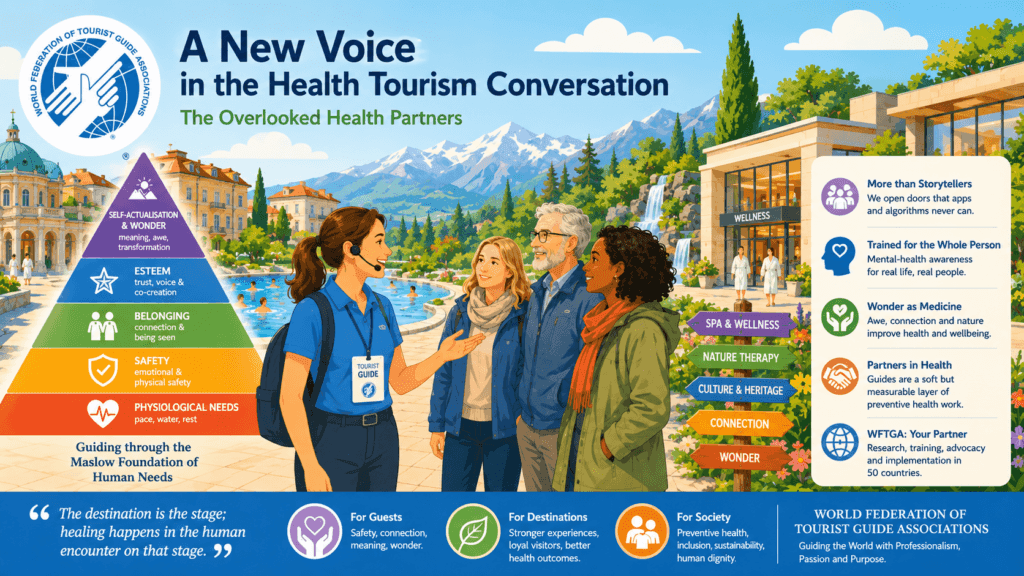
A New Voice in the Health Tourism Conversation
The Overlooked Health Partners
Whilst Europe debates the future of health tourism — from spa towns and salt caves to forest bathing, alpine recovery and resort-based wellness — one professional group works quietly at the very point where a destination becomes a healing experience: professional tourist guides. They are the people who, in those decisive first hours, decide whether a guest arrives in a place — or truly arrives in themselves.
The problem? Tourist guides are still systematically overlooked in health tourism strategy.
More than Storytellers: The True Power of Tourist Guides
A professional tourist guide is not a walking encyclopaedia. A professional tourist guide is a host, a moderator, a companion — for a few hours or a few days, something close to a friend on location. We know our region. More importantly, we know the people in it: the baker who still uses his grandfather’s recipe, the herbalist who picks the same hillside her mother picked, the woman who tends the chapel that nobody else visits. We can open doors that no booking platform and no app will ever open, because those doors are not opened by transactions. They are opened by trust — built person to person, over years, inside a local community.
This is why a guided experience cannot be replaced by a video, an audio file, or even the most beautifully written guidebook. Those formats deliver information. Tourist guides deliver relationship. And in health tourism, relationship is the active ingredient.
The Maslow Foundation: Why Quality Guiding Is Health Work
Every experienced tourist guide instinctively works through Maslow’s pyramid of human needs, even when we never name it. Our work always begins at the base, not at the summit:
Physiological needs – pace, water, shade, rest stops, accessible routes. A guest who is dehydrated or exhausted cannot receive culture, let alone healing.
Safety – emotional safety as much as physical safety. No embarrassment about language, walking pace, or what a guest does or does not know. A guest who feels unsafe cannot feel awe.
Belonging – the small, friendly group, the warm welcome, the sense of being seen as a person, not processed as a number. A guest who feels invisible cannot connect.
Esteem – being trusted with stories, being asked for an opinion, being treated as a co-author of the experience rather than a passive consumer.
Self-actualisation and wonder – the wow moment: that quiet seizure of the heart when a person realises something beautiful or true about a place, about themselves, about the world.
A guide who skips the base of the pyramid and jumps straight to facts and dates is doing tourism wrong. In a health context, that same guide can actively cause harm.
Wonder as Medicine: The Evidence Base
Peer-reviewed research now shows what guides have long suspected: experiences of awe, meaningful place-attachment, and genuine human connection lower stress hormones, improve sleep quality, ease symptoms of mild depression and anxiety, and strengthen immune response. A well-guided two-hour walk can do for a person what a glossy brochure cannot do in a year.
This is not poetry. This is increasingly measurable medicine — and it places the tourist guide much closer to the public health conversation than current policy reflects.
Trained for the Whole Person
In cooperation with our European colleagues at the Federation of European Tourist Guide Associations (FEG), WFTGA actively promotes mental-health awareness training for guides. Because the guests we meet are not always on holiday in the old sense:
- They are in recovery from illness, surgery, or burnout.
- They are grieving.
- They are neurodivergent.
- They live with chronic pain or invisible illness.
- They carry anxieties they will never list on a registration form.
A trained guide notices the small signs. A trained guide adapts the route, the tempo, the volume of the voice, the length of the silences. A trained guide knows when to speak — and, just as importantly, when not to speak.
What No Algorithm and No Clinician Can Replicate
No nurse, no therapist, no app, and no algorithm can replace what a tourist guide offers in those hours — not because we are better than nurses or therapists, but because we are different. We meet people not in a clinical setting, not behind a desk, not in a treatment room, but outside, walking, on equal footing.
We are not the carer. We are not the doctor. For those few hours we are something rarer in modern life: a knowledgeable friend who is taking the guest somewhere beautiful and noticing them as a human being while doing so. Companionship at eye level. That is something the health system cannot prescribe — but tourism, properly understood, can offer it.
And notice: this is not really about the destination at all. It can happen in a Lithuanian spa town, in a Romanian salt mine, on a Spanish village walk, in a Hungarian thermal bath, on an Austrian alpine path. The destination is the stage. The healing happens in the human encounter on that stage.
A Call for Partnership
- To Health Destinations and Resorts: Bring the guide in early. Treat tourist guides as strategic partners in product design, not as logistical afterthoughts booked the week before arrival.
- To Public Health Institutions: Recognise tourist guides as a soft but measurable layer of preventive health work. Include us in research on the wellbeing impact of cultural and nature-based experiences.
- To Spa and Wellness Associations: Co-develop training pathways that integrate hospitality, interpretation, and mental-health awareness — so that the human side of the guest journey matches the quality of your facilities.
- To Tour Operators and DMCs: Stop competing on price by booking the cheapest available “tour guide”. Invest in licensed, professional tourist guides. The difference is felt by every guest, every time.
- To Researchers and Journalists: Tourist guides are an authentic, under-used source of field data on visitor wellbeing, place-attachment, and healing-by-experience.
- To Policymakers: Include tourist guides in health-tourism strategy and funding programmes. Field expertise of this depth is irreplaceable.
WFTGA: Your Partner for Health-Aware Guiding
The World Federation of Tourist Guide Associations is ready to act as:
- Research partner for studies on guiding, wellbeing, and healing-by-experience
- Training partner for joint programmes on mental-health awareness, accessibility, and inclusive guiding
- Advocacy partner for the recognition of guiding as a contributor to public health
- Implementation partner through our 90 member associations in 50 countries
Concrete WFTGA initiatives supporting this agenda:
- Continuous Professional Development (CPD) modules on mental-health awareness, accessibility, and inclusive guiding
- An updated Code of Guiding Practice that names the guide’s responsibility for the whole person, not just the itinerary
- The WFTGA Convention 2026 in Fukuoka, Japan — a meeting place for guides, destinations and partners committed to a more humane tourism
- Cooperation with the Federation of European Tourist Guide Associations (FEG) on mental-health-aware guiding
The Turning Point is Now
Health tourism in Europe is at a turning point. The locations are world-class. The treatments are world-class. The science is catching up. What is still missing — too often — is the human bridge between the guest and the place. Tourist guides are ready to be that bridge. They simply need partners who recognise and use their expertise.
“When we guide a guest through a healing landscape, we are not delivering content. We are creating conditions — for safety, for connection, for wonder. No algorithm can hold a person’s attention with that kind of care. No app can sense when a guest needs a quieter route, a longer pause, a different question. The destination is the stage; healing happens in the human encounter on that stage. It is time we recognise tourist guides not as service providers, but as partners in public health.”
Sebastian Frankenberger, President World Federation of Tourist Guide Associations
The question is not whether tourist guides can contribute to Europe’s health tourism. The question is whether Europe’s health tourism is wise enough to invite them in.